Health and Safety Policy for a Removal Company in Barnet
 A strong health and safety policy is essential for any removal company in Barnet. It helps protect staff, customers, property, and the wider public during every stage of the moving process. From lifting heavy furniture to moving fragile items through narrow spaces, each task carries risks that must be managed carefully. This policy sets out the standards expected of all employees and outlines how safe working practices are maintained across domestic and commercial removals.
The company is committed to providing a safe and healthy working environment, with procedures designed to reduce accidents, prevent injury, and support responsible decision-making. Every move must be planned with care, with attention to hazards such as slips, trips, falls, poor manual handling, and vehicle movement. Safety is not treated as a separate activity; it is part of everyday operations and applies to all personnel, contractors, and anyone assisting with a removal.
All workers are expected to follow this policy, use equipment correctly, and report concerns immediately. Management is responsible for maintaining clear procedures, supplying suitable equipment, and ensuring that staff receive the information they need to work safely. This includes regular monitoring, training, and review of working methods so that the service remains reliable and professional.
Core Safety Responsibilities
The company recognises that safe removals depend on shared responsibility. Management must carry out suitable risk assessments before work begins, especially where access is restricted, stairs are involved, or valuable and awkward items require special handling. Employees must cooperate with instructions, use correct lifting methods, and wear any required personal protective equipment. Safety rules must be followed regardless of time pressure or workload.
Manual handling is one of the most important concerns in the removals industry. Staff should assess the weight, shape, and stability of each item before lifting. Where possible, loads should be broken down into smaller parts, and mechanical aids such as trolleys, straps, and blankets should be used to reduce strain. Team lifting must be organised for large or heavy objects, and no worker should attempt a lift beyond their capability.
Vehicles used for removals must be kept in safe working condition and loaded in a way that prevents shifting during transit. Drivers should check the load before departure and after stops, particularly where long journeys or repeated braking could affect stability. Secure loading is vital to protect both the crew and the customer’s belongings.
Workplace Hazards and Prevention
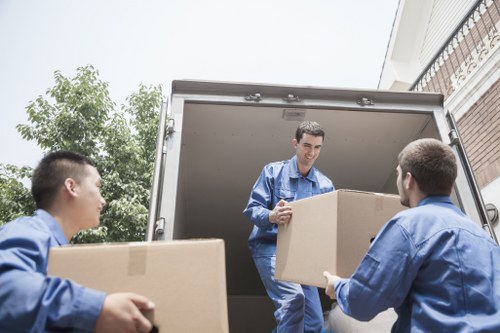 Risks inside homes, offices, storage areas, and shared buildings must be controlled with care. Common hazards include loose flooring, poor lighting, wet surfaces, trailing cables, and blocked pathways. Staff should keep routes clear, use suitable footwear, and ensure that entrances and stairways remain as unobstructed as possible. If a hazard cannot be made safe immediately, the area should be avoided until control measures are in place.
When handling furniture and boxes, employees must take care not to damage walls, doors, or flooring, but also to avoid putting themselves in awkward positions. Protective materials such as covers and padding may be used to reduce both property damage and injury risk. During loading and unloading, communication between team members is essential, especially when moving large items through tight spaces or around corners.
Special attention should be given to weather-related risks. Rain, ice, strong winds, and heat can all affect safety during outdoor loading and unloading. In poor conditions, extra time should be allowed, surfaces should be checked more frequently, and heavy items should be handled with added caution. Staff should never rush at the expense of control and stability.
Training, Equipment, and Incident Reporting
 The company will ensure that workers receive appropriate induction and ongoing training relevant to their duties. Training covers safe lifting, safe driving awareness, correct use of equipment, hazard identification, and basic emergency response. New staff should not be left to work unsupervised until they have demonstrated a proper understanding of these requirements. Refresher training should be given where needed, particularly after incidents or changes in working methods.
All equipment must be suitable for its intended use, regularly inspected, and stored correctly when not in use. Damaged items must be removed from service immediately. Well-maintained equipment supports safe work and helps prevent avoidable injuries. Employees are responsible for checking tools and aids before use and reporting faults without delay.
Any accident, near miss, injury, or unsafe condition must be reported promptly to management. Incidents should be recorded and reviewed so that corrective action can be taken. This process helps identify patterns, improve procedures, and prevent similar problems from happening again. A culture of openness encourages staff to speak up early rather than ignore developing risks.
Emergency Response and Policy Review
 In an emergency, staff must act calmly and follow the appropriate response for the situation. This may include stopping work, moving to a safe area, calling emergency services, or providing basic first aid where trained to do so. Access routes should be kept open wherever possible so that assistance can reach the scene quickly. Every worker should know who to notify and how to escalate serious concerns.
The company also expects all personnel to behave responsibly when working in occupied homes or active business premises. Respect for the client’s environment must be balanced with safety. Items should be moved carefully, noise kept to a reasonable level, and work paused if conditions become unsafe. A removal team that acts thoughtfully is more likely to complete the job efficiently and without incident.
 This policy will be reviewed regularly to ensure it remains effective, practical, and aligned with current working practices. Feedback from internal audits, incident reports, and operational experience will help guide improvements. The goal is to maintain a safe, organised, and dependable Barnet removal service that protects everyone involved while delivering high standards of care and professionalism.